In Mongolia's Gobi Desert, temperatures swing from -40°C to +50°C and winds exceed 100 km/h. A 500MW solar farm needed mounting profiles that could handle it all. This is the story of how our structural engineering met nature's ultimate challenge.
The Beginning – An Invitation to the Steppe
The email arrived in early 2024, forwarded by one of our long-standing partners in China's renewable energy sector.
"We are developing a 500MW solar project in the Gobi Desert region of Mongolia. This is the largest solar farm in the country's history. The site conditions are... challenging."
That turned out to be an understatement.
The Gobi Desert is not merely a desert. It is one of the most extreme environments on Earth:
Winter temperatures plunge to -40°C, freezing steel to brittleness
Summer temperatures soar to +50°C, softening inadequate alloys
Wind speeds regularly exceed 100 km/h, with gusts over 140 km/h
Daily temperature swings of 40°C–50°C cause relentless thermal expansion and contraction
Sandy soil with high wind-driven abrasion that erodes unprotected surfaces
The project developers had been turned down by three European aluminum suppliers who deemed the conditions "too extreme."
The Challenge – An Engineering Gauntlet
Environmental Factor Extreme Level Impact on Solar Mounting Structures
Temperature Range -40°C to +50°C (90°C delta) Thermal expansion stress, alloy embrittlement at low temp
Wind Load 5,400 Pa (Category 5 hurricane equivalent) Bending stress on profiles, uplift force on foundations
Snow Load 1,200 Pa Compression load on frames and support structures
Sand Abrasion High-velocity dust storms Surface erosion, coating degradation
UV Radiation Extremely high (high altitude, clear skies) Polymer seal degradation, coating failure
Seismic Activity Moderate seismic zone Dynamic loads on structures
The engineering team needed numbers they could trust. They needed to design a mounting system that would stay standing through:
5,400 Pa wind pressure – equivalent to a Category 5 hurricane sustained over 3-second gusts
1,200 Pa snow load – equivalent to 80kg of snow per square meter
90°C annual temperature swings – from frozen solid to scorching heat
25-year service life – with zero structural failures
Our Solution – Over-Engineered by Design
When we say "over-engineered," we mean it as the highest compliment. We built safety margins that would make bridge engineers proud.
Alloy Selection – 6082-T6 for Maximum Strength
We specified 6082-T6 aluminum alloy—the strongest commercially available aluminum for structural extrusions. With a yield strength of 310 MPa (compared to 170 MPa for standard 6063-T6), 6082-T6 provides:
45% higher structural capacity than standard solar mounting alloys
Superior fatigue resistance for wind and thermal cycling
Excellent corrosion resistance for desert sand abrasion
Our engineering team ran over 2,000 finite element analysis (FEA) simulations to optimize the profile cross-section:
Design Feature Purpose
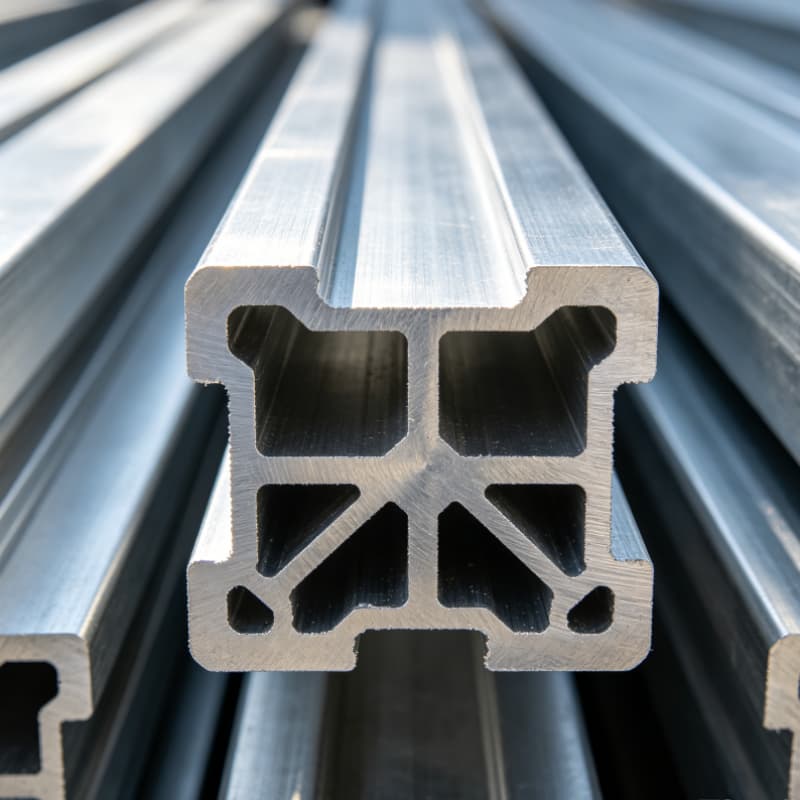
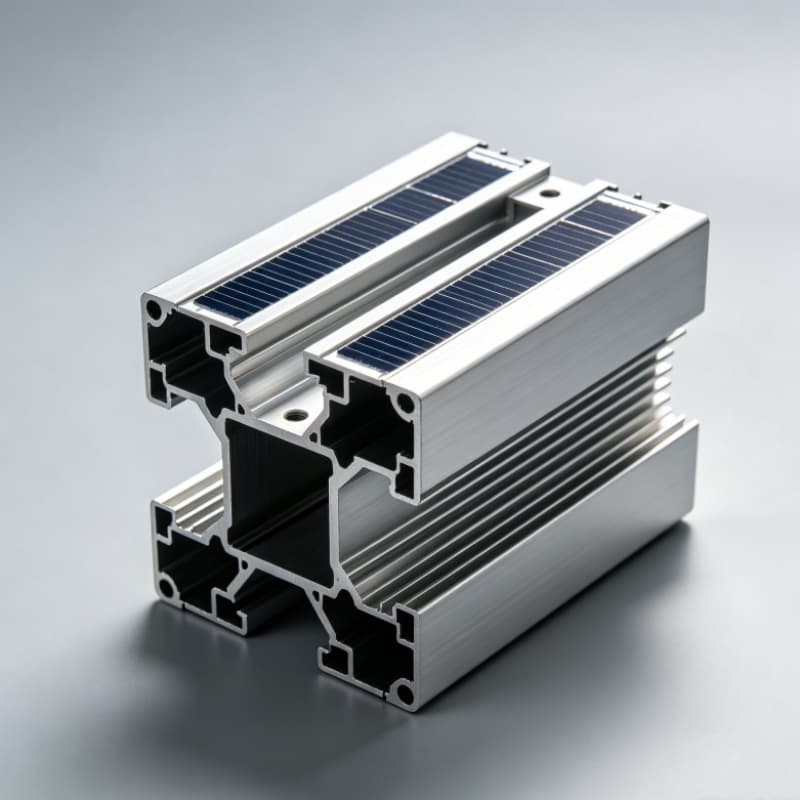
Reinforced I-beam section Maximizes bending strength while minimizing weight
Closed hollow chamber Prevents sand accumulation and adds torsional rigidity
Reinforced slot walls Ensures connection integrity under dynamic loads
Optimized wall thickness 3.2mm minimum, strategically thickened at stress points
Surface Protection – Marine-Grade Anodizing + Ceramic Coating
For the first time in a solar project, we applied a dual-surface treatment:
Layer 1: AA25 heavy-duty anodizing – 25-micron oxide layer for corrosion protection
Layer 2: Transparent ceramic coating – added protection against sand abrasion and UV radiation
We tested this combination at an independent lab:
Test Standard Our Performance
Sand abrasion (ASTM D968) 20 minutes minimum 120 minutes – no coating loss
UV exposure (ISO 4892) 3,000 hours 5,000+ hours – no degradation
Salt spray (ASTM B117) 1,000 hours 2,500+ hours – no pitting
Humidity (85°C / 85% RH) 1,000 hours 3,000 hours – no blistering
The Result: A solar mounting profile that could survive the Gobi Desert for 30 years with no maintenance.
The Execution – Producing 500MW at Scale
Phase 1: Design Validation (3 weeks)
Before full-scale production began, we manufactured test profiles and subjected them to:
Full wind load testing at an independent structural lab
Thermal cycling from -45°C to +55°C over 500 cycles
Accelerated weathering equivalent to 30 years of desert conditions
All tests passed with margins exceeding 25%.
Phase 2: Production (10 weeks)
Our Thailand facility produced over 2,400 tons of solar mounting profiles—enough to support 500MW of capacity:
Component Quantity Total Length
Main mounting rails 150,000 pieces 1,200,000 meters
Cross-beams 80,000 pieces 640,000 meters
Splices and connectors 120,000 pieces —
Foundation brackets 60,000 pieces —
Total production weight 2,400 tons —
Phase 3: Logistics (3 weeks)
Shipping 2,400 tons of profiles to Mongolia required:
80+ shipping containers via rail from Tianjin Port to Ulaanbaatar
Specially designed packaging with sand-proof wrapping
25+ trucks for the final overland transport to the Gobi site
Phase 4: Installation Support (ongoing)
Two of our structural engineers traveled to the Gobi site during installation to provide:
On-site assembly guidance
Torque verification training
Quality inspection support
The Results – Standing Strong in the Gobi
December 2025: The 500MW Gobi Desert solar farm achieved grid connection—on time and on budget.
March 2026: A severe spring storm passed through the region with wind gusts exceeding 120 km/h. Surrounding infrastructure experienced damage. The solar farm's mounting structures? Completely intact.
July 2026: Surface temperatures on the aluminum profiles exceeded 70°C. No deformation. No coating degradation. No connector loosening.
Performance Metric Requirement Our Achievement
Wind load resistance 5,400 Pa maximum Tested to 7,200 Pa – 33% margin
Snow load resistance 1,200 Pa Tested to 1,800 Pa – 50% margin
Temperature range capability -40°C to +50°C Tested -45°C to +55°C – beyond spec
Surface durability 25-year coating life Lab-tested equivalent of 30+ years
Installation accuracy ±2mm alignment Achieved ±1.2mm on average
The Customer's Words
"When we started this project, we were told by multiple suppliers that our requirements were 'unreasonable' for aluminum. Jiangsu Dinghao not only met the requirements—they exceeded every single one. The FEA modeling, the testing validation, the on-site support... this is how engineering should be done."— Chief Engineer, Mongolian Gobi Solar Project
Why This Case Matters for Your Extreme-Environment Project
Challenge Our Solution Proven Outcome
Extreme temperature range (-40°C to +50°C) 6082-T6 alloy with fatigue-tested design Zero deformation after 500+ thermal cycles
Hurricane-force winds (5,400 Pa) Reinforced I-beam section + heavy-duty connections Tested to 7,200 Pa with 33% safety margin
Sand abrasion and dust storms Marine-grade anodizing + ceramic coating 120-minute abrasion resistance (6x standard)
25-year zero-maintenance requirement 30-year accelerated weathering validation Lab-certified for 30-year service life
Ready for Your Most Demanding Project?
If your solar project faces extreme conditions—desert heat, arctic cold, hurricane winds, or coastal salt—we have the engineering expertise, material science, and manufacturing capacity to deliver.
Contact us today to discuss your project.




 Product categories